First Session in Latest Webinar Series Explores - From Theory to Action: Who Owns Road Safety?
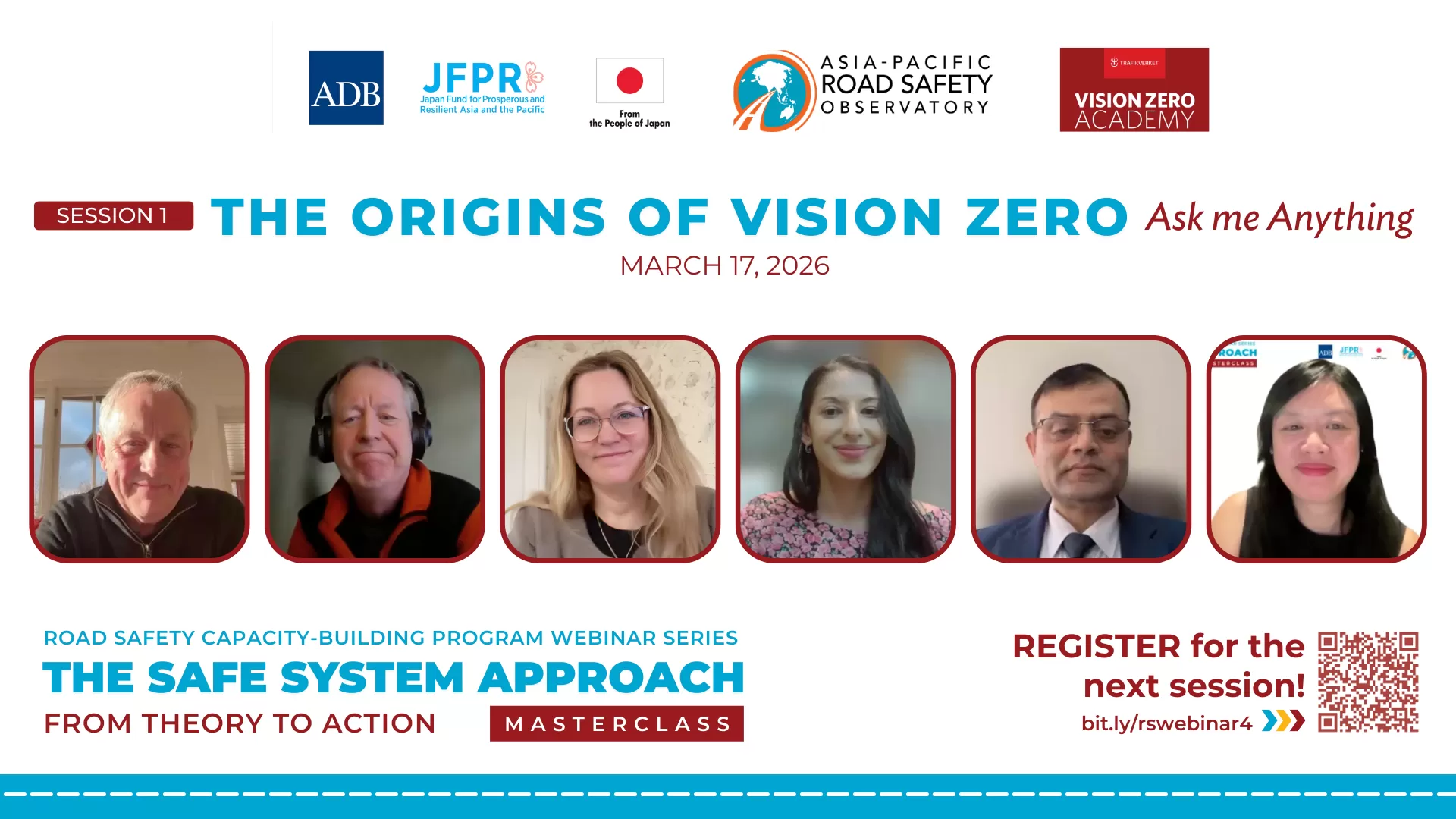
On 17 March 2026, the first 2026 installment of the Road Safety Capacity-Building Program webinar series was launched. Titled Road Safety Capacity-Building Program Webinar Series Masterclass – The Safe System Approach: From Theory to Action, the series is co-presented by the Asia Pacific Road Safety Observatory (APRSO) and the Asian Development Bank (ADB), in partnership with Vision Zero Academy. The webinar series is supported by a grant from the Japan Fund for Prosperous and Resilient Asia and the Pacific (JFPR), financed by the Government of Japan through the ADB.
The session drew 206 participants from 68 countries, reflecting strong global engagement—particularly from regions carrying the highest burden of road deaths including Asia and the Pacific, Africa, and Latin America. It was moderated by Jessica Truong, Director at Lösningar.
Priti Gautam, Senior Transport Specialist and road safety lead at the ADB, framed the discussion against the challenges faced by countries in the Asian region in delivering road safety, particularly to translate good practices done by high-performing countries into the region’s unique context with a wide range of road users – pedestrians, cyclists, people who use both formal and informal transport. She emphasized that it is in very complex road environments – as seen in Asian countries – where the Safe Systems approach becomes super relevant.
Sushil Dhakal, Joint Secretary of the Nepal Ministry of Physical Infrastructure and Transport and Chairperson of the Steering Committee of the Asia-Pacific Road safety Observatory, provided details to highlight the urgency to deliver road safety in the region: Asia-Pacific accounts for around 65% of global road fatalities, yet the problem is not a lack of solutions. Instead, countries face gaps in aligning policies, institutions, and investments with Safe System principles.
This is where the Vision Zero philosophy would come in, not just as a target, but as an ethical commitment, shared by Eva Björk, International Operations Manager at the Vision Zero Academy. Vision Zero, Eva emphasized, is a strategic framework that places human life at the center of the transport system, built on the principle that no loss of life is acceptable in road traffic.
These discussions set the stage for Claes Tingvall, the founder of Vision Zero, to shed light on how the philosophy was – at the time it began to be shaped in the 1990s – provocative to the traditional tenets of transport planning. Vision Zero, Claes mentioned, placed the safety of people as the starting point of the road transport system where traditionally, safety would be traded off against other factors such as mobility or costs.
According to Claes, Vision Zero is underpinned by the principle that safety of the road transport system lies in those who have prepared the system for making sure that it is safe for people using it – in those who design, organize, and apply solutions to a road transport system.
Building on this, Peter Larsson, Senior Advisor on Road Safety at the Swedish Transport Administration, highlighted the need to align road safety within broader sustainable development frameworks, where safety is not a competing objective – to other objectives such as mobility or cost minimization – but an integral condition for a functional and equitable transport system.
The webinar series will continue with the second session scheduled on 31 March 2026. Read more about the upcoming sessions here.