Second Webinar Session Explores the Science of Child & Vulnerable Person Road Safety
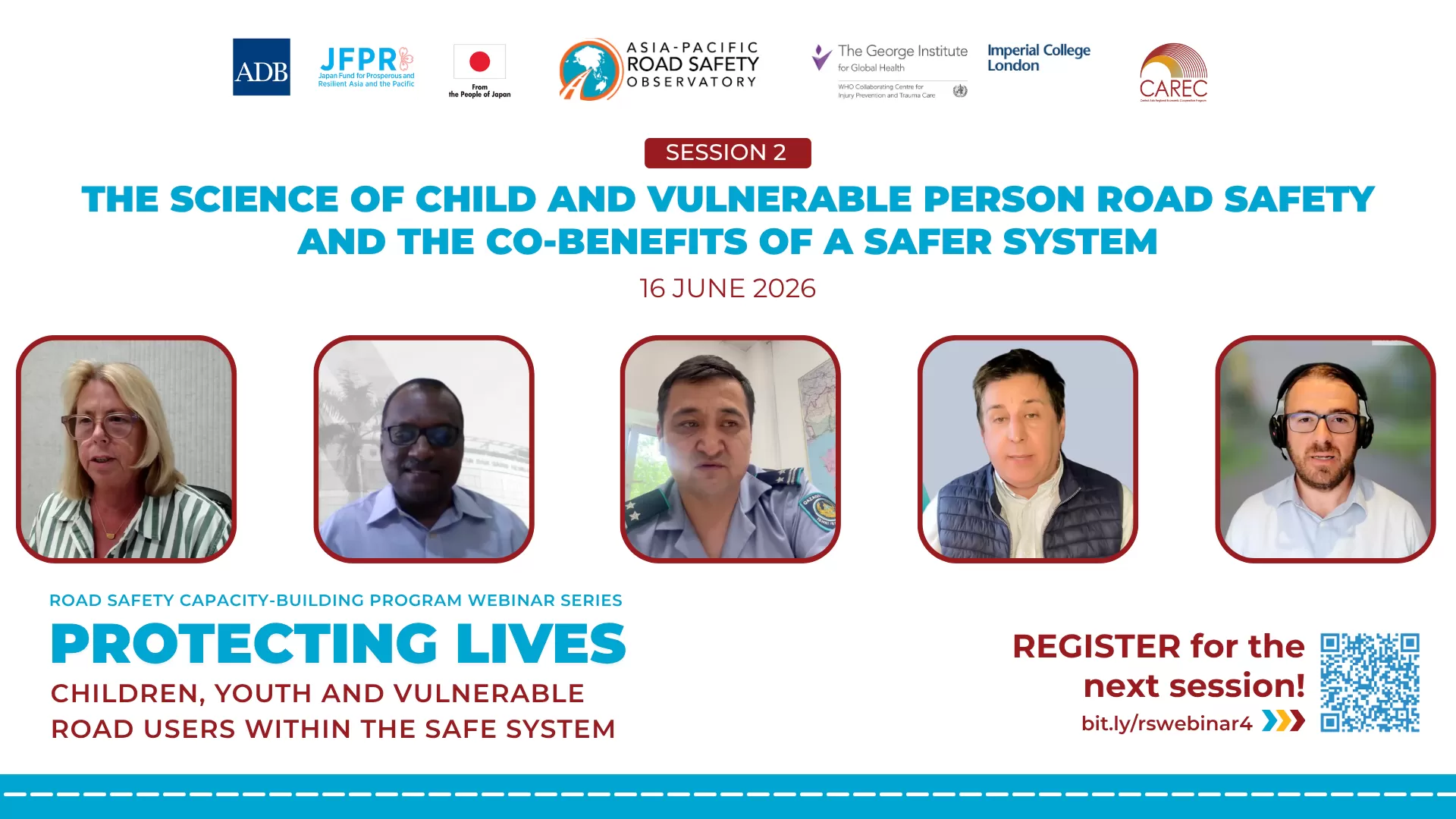
On 16 June 2026, the webinar series continued with its second session, titled “The Science of Child & Vulnerable Person Road Safety and the Co-Benefits of a Safer System.” Co-presented by the Asia Pacific Road Safety Observatory (APRSO) and the Asian Development Bank (ADB), the session brought together over 120 participants, with strong engagement throughout reflecting the high level of interest in the topic.
The webinar series is supported by a grant from the Japan Fund for Prosperous and Resilient Asia and the Pacific (JFPR), financed by the Government of Japan through ADB.
Julie Brown from The George Institute for Global Health opened the technical discussions by unpacking the science behind vulnerability in road safety. She highlighted that children are not simply “small adults”—their developing bodies respond differently to crash forces, with higher susceptibility to serious injury even at lower thresholds. She also pointed to the unique risks faced by older adults due to reduced physiological resilience.
Building on this, Kulanthayan KC Mani shared insights from Safe Kids Malaysia, highlighting how children’s perception of vehicles as familiar and “friendly” objects can lead to unsafe behavior around traffic, as children receive cars and trucks as toys to play with. This, among other factors, leads to children being unable to understand risk independently, which requires adults to design and provide safer environments that account for these developmental limitations.
Tanat Assylzhanov from the Department of Road Safety, Kazakhstan then presented a systems-level perspective, showcasing how road safety efforts extend beyond enforcement. He highlighted the proactive role of police in public outreach, as well as strong coordination with the education sector and other ministries.
Closing the session, Gary Haq of Stockholm Environment Institute shared practical examples from Indonesia, demonstrating how participatory and inclusive approaches, such as community mapping, co-design workshops, and tactical urbanism, can help better understand and respond to the lived experiences of vulnerable road users.
The session reinforced the idea that vulnerability should be understood a mismatch between people and the system they navigate, reinforcing the need for Safe System designs that better reflect human limits.
The webinar series will continue with its next session scheduled for 30 June 2026. Read more about the upcoming sessions here.