AI for Safety Performance Indicators Featured at Safety 2026
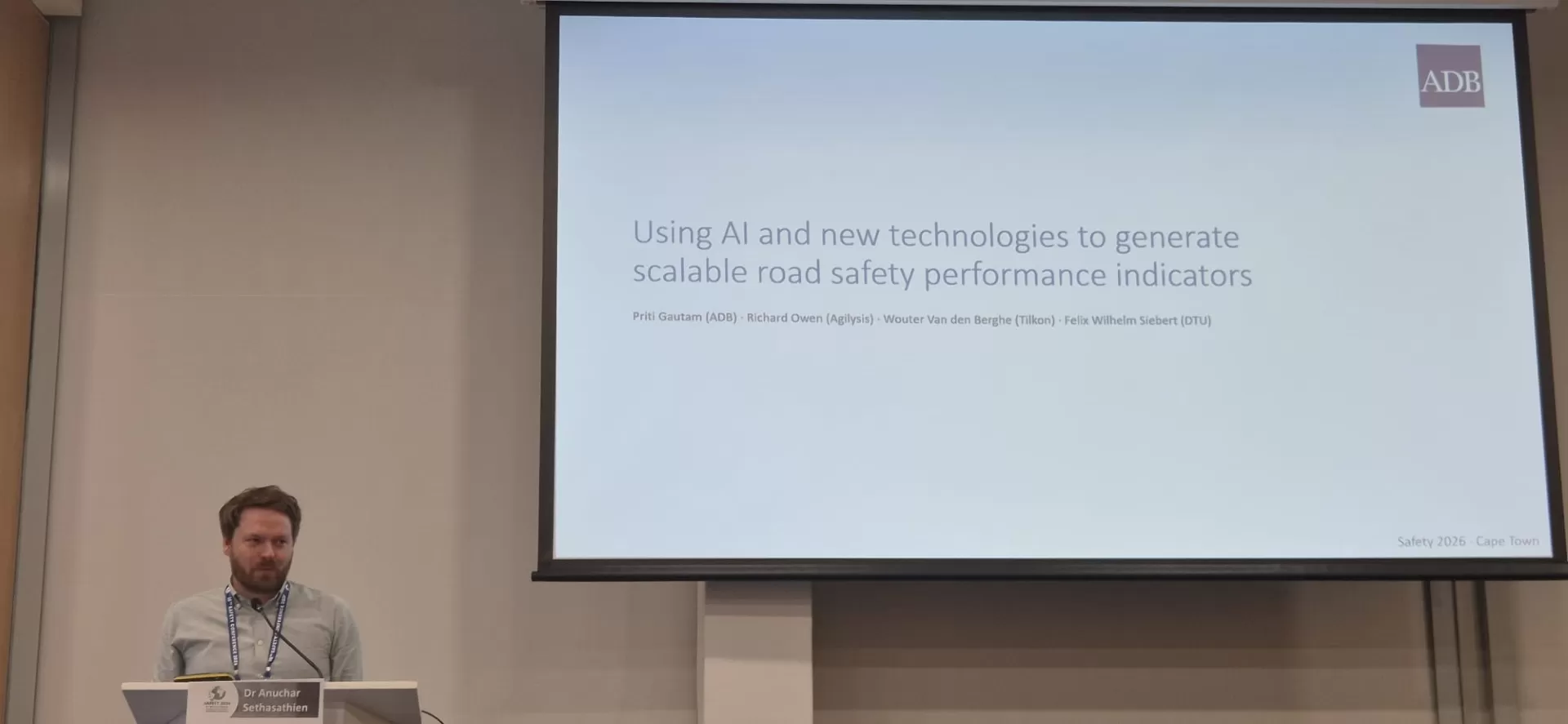
Research supported by the Asia-Pacific Road Safety Observatory (APRSO) and the Asian Development Bank (ADB) on the use of artificial intelligence (AI) and emerging technologies to generate scalable road safety performance indicators (SPIs) in low- and middle-income countries was presented at the 16th World Conference on Injury Prevention and Safety Promotion (Safety 2026) in Cape Town, South Africa.
Associate Professor Felix Wilhelm Siebert from the Technical University of Denmark, a member of the project team led by Agilisys (United Kingdom) with Tilkon (Denmark), presented key findings during a session chaired by researchers from Johns Hopkins University and The George Institute for Global Health. The session brought together academics and practitioners from institutions including Monash University, the University of the West of England, the Nepal Injury Research Centre, and Vital Strategies.
The presentation highlighted innovative approaches to addressing road safety data gaps through AI and emerging technologies, enabling countries to generate safety performance indicators more efficiently and at scale. The research focused on developing new methods to measure key indicators such as the road network carrying the majority of traffic, the prevalence of speeding, and helmet-wearing rates among powered two-wheeler users. These indicators can help countries better target investments, enforcement, and other interventions to improve road safety outcomes.
The full report, supported by the ADB's High-Level Technology Fund, will be made available at the Observatory's Knowledge and Innovation Hub shortly.